Ankyrin G Antibody [N106/20 (Formerly sold as S106-20)]
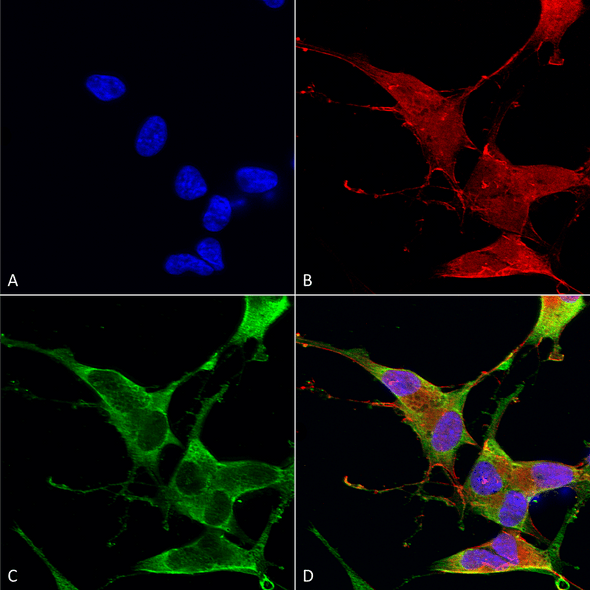
Ankyrin G Antibody [N106/20 (Formerly sold as S106-20)] is a mouse monoclonal antibody directed against Ankyrin G, offered by Assay Genie for research applications. Reported applications include WB and ICC/IF. Reported reactivity: Human, Mouse and Rat. Supplied as IgG1, purified by Protein G.
Ankyrin-G (ANK3) is a critical scaffolding protein that anchors integral membrane proteins to the spectrin-actin cytoskeleton, ensuring the structural and functional integrity of excitable cells, particularly neurons. It binds to the β-spectrin subunit and a wide array of membrane proteins, including voltage-gated sodium channels, potassium channels, and cell adhesion molecules, orchestrating their precise localization at the axon initial segment (AIS) and nodes of Ranvier. In the central nervous system, Ankyrin-G plays a pivotal role in maintaining neuronal polarity, regulating action potential initiation, and preserving synaptic stability. Disruption of Ankyrin-G function leads to mislocalization of ion channels and cytoskeletal disorganization, contributing to impaired neuronal signaling. Emerging evidence links ANK3 mutations and dysregulation to a spectrum of neuropsychiatric and neurodegenerative disorders, including bipolar disorder, schizophrenia, epilepsy, and Alzheimer’s disease. In Alzheimer’s models, Ankyrin-G dysfunction has been associated with AIS disassembly and increased neuronal vulnerability, suggesting a mechanistic link between cytoskeletal breakdown and neurodegeneration. Given its central role in neuronal architecture and excitability, Ankyrin-G is increasingly recognized as a potential biomarker and therapeutic target in neurodegenerative disease research. Understanding its molecular interactions and regulatory mechanisms is essential for developing strategies to preserve neuronal function and prevent disease progression. This antibody is also available conjugated to ATTO 390, ATTO 488, ATTO 594, APC, Biotin, FITC, HRP, PerCP and RPE. Supplied in 100 µg. For research use only; not for diagnostic or therapeutic procedures.
Product Name:
Ankyrin G Antibody [N106/20 (Formerly sold as S106-20)]
Store at -20°C. Shipped on Blue Ice or 4°C. Conjugated variants should be stored according to the product label.
Format:
Liquid
Applications:
WB, ICC/IF
Antibody Isotype:
IgG1
Purification:
Protein G Purified
Concentration:
1 mg/ml
Reactivity:
Human, Mouse, Rat
Recommended Dilution:
WB (1:1000), ICC/IF (1:100); optimal dilutions for assays should be determined by the user.
Specificity:
Detects >~200kDa.
Guarantee:
12 months from date of dispatch
Immunogen:
Fusion protein 1000 C-terminal amino acids of human Ankyrin G (also known as ANK-3 or ankyrin-3) encompassing all of Ankyrin G with the exception of Ankyrin repeats
Ankyrin R Antibody [N388A/10 (Formerly sold as S388A-10)]Ankyrin R Antibody [N388A/10 (Formerly sold as S388A-10)] is a mouse monoclonal antibody directed against Ankyrin R, offered by Assay Genie...
Ankyrin B Antibody [N105/13 (Formerly sold as S105-13)]Ankyrin B Antibody [N105/13 (Formerly sold as S105-13)] is a mouse monoclonal antibody directed against Ankyrin B, offered by Assay Genie for...
Sulfotyrosine Antibody [12B11 (Formerly sold as 7C5)]Sulfotyrosine Antibody [12B11 (Formerly sold as 7C5)] is a mouse recombinant monoclonal antibody directed against Sulfotyrosine, offered by Assay...
system_update_altDatasheetHuman Interleukin 20 (IL-20) ELISA KitThe Human Interleukin-20 (IL-20) ELISA Kit is a highly sensitive and specific assay designed for the accurate d
system_update_altDatasheetMouse Interleukin 20 (IL-20) ELISA KitThe Mouse Interleukin-20 (IL-20) ELISA Kit is a reliable and sensitive assay designed for the accurate detectio