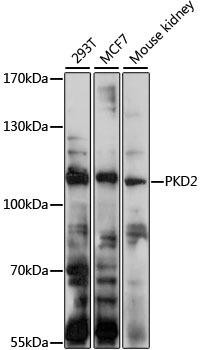


Description
| 抗体名: | PKD2 Antibody (PACO11267) |
| 抗体コード: | PACO11267 |
| サイズ: | 50ul |
| 宿主種: | Rabbit |
| 申し込み: | ELISA, WB |
| 推奨される希釈: | |
| 反応性: | Human, Mouse, Rat |
| 免疫原: | Human PKD2 |
| 憲法: | Liquid |
| ストレージバッファ: | PBS with 0.02% Sodium Azide, 50% Glycerol, pH 7.3. -20°C, Avoid freeze / thaw cycles. |
| 精製方法: | Antigen Affinity purified |
| 抗体のクローン性: | Polyclonal |
| アイソタイプ: | IgG |
| Conjugate: | Non-conjugated |
| シノニム: | polycystic kidney disease 2 (autosomal dominant);PKD2;APKD2;MGC138466;MGC138468;PC2;PKD4 ; |
| UniProt Protein Function: | PKD2: Involved in fluid-flow mechanosensation by the primary cilium in renal epithelium. PKD1 and PKD2 may function through a common signaling pathway that is necessary for normal tubulogenesis. Acts as a regulator of cilium length, together with PKD1. The dynamic control of cilium length is essential in the regulation of mechanotransductive signaling. The cilium length response creates a negative feedback loop whereby fluid shear-mediated deflection of the primary cilium, which decreases intracellular cAMP, leads to cilium shortening and thus decreases flow-induced signaling. Functions as a calcium permeable cation channel. Defects in PKD2 are the cause of polycystic kidney disease autosomal dominant type 2 (ADPKD2). ADPKD2 is a disorder characterized by progressive formation and enlargement of cysts in both kidneys, typically leading to end-stage renal disease in adult life. Cysts also occurs in the liver and other organs. It represents approximately 15% of the cases of autosomal dominant polycystic kidney disease. ADPKD2 is clinically milder than ADPKD1 but it has a deleterious impact on overall life expectancy. Belongs to the polycystin family. 5 isoforms of the human protein are produced by alternative splicing. |
| UniProt Protein Details: | Protein type:Membrane protein, integral; Channel, cation; Membrane protein, multi-pass Chromosomal Location of Human Ortholog: 4q22.1 Cellular Component: filamentous actin; endoplasmic reticulum membrane; nonmotile primary cilium; endoplasmic reticulum; integral to plasma membrane; lamellipodium; cytoplasm; basal plasma membrane; plasma membrane; motile primary cilium; intercellular junction; basal cortex; cilium Molecular Function:voltage-gated cation channel activity; actinin binding; identical protein binding; protein homodimerization activity; phosphoprotein binding; voltage-gated ion channel activity; calcium ion binding; muscle alpha-actinin binding; ATPase binding; calcium-induced calcium release activity; voltage-gated calcium channel activity; protein binding; potassium channel activity; voltage-gated sodium channel activity; cytoskeletal protein binding; HLH domain binding; receptor binding Biological Process: neural tube development; positive regulation of inositol-1,4,5-triphosphate receptor activity; embryonic placenta development; cytoplasmic sequestering of transcription factor; positive regulation of nitric oxide biosynthetic process; regulation of cAMP metabolic process; heart development; detection of mechanical stimulus; JAK-STAT cascade; liver development; G1/S-specific positive regulation of cyclin-dependent protein kinase activity; regulation of cell proliferation; negative regulation of cell proliferation; ureteric bud branching; spinal cord development; release of sequestered calcium ion into cytosol; calcium ion transport; positive regulation of transcription from RNA polymerase II promoter; heart looping; cell cycle arrest; determination of left/right symmetry; centrosome duplication Disease: Polycystic Kidney Disease 2 |
| NCBI Summary: | This gene encodes a member of the polycystin protein family. The encoded protein is a multi-pass membrane protein that functions as a calcium permeable cation channel, and is involved in calcium transport and calcium signaling in renal epithelial cells. This protein interacts with polycystin 1, and they may be partners in a common signaling cascade involved in tubular morphogenesis. Mutations in this gene are associated with autosomal dominant polycystic kidney disease type 2. [provided by RefSeq, Mar 2011] |
| UniProt Code: | Q13563 |
| NCBI GenInfo Identifier: | 116242717 |
| NCBI Gene ID: | 5311 |
| NCBI Accession: | Q13563.3 |
| UniProt Secondary Accession: | Q13563,O60441, Q15764, Q2M1Q3, Q2M1Q5, |
| UniProt Related Accession: | Q13563 |
| Molecular Weight: | 968 |
| NCBI Full Name: | Polycystin-2 |
| NCBI Synonym Full Names: | polycystic kidney disease 2 (autosomal dominant) |
| NCBI Official Symbol: | PKD2 |
| NCBI Official Synonym Symbols: | PC2; PKD4; Pc-2; APKD2; TRPP2 |
| NCBI Protein Information: | polycystin-2; R48321; polycystwin; autosomal dominant polycystic kidney disease type II protein; transient receptor potential cation channel, subfamily P, member 2 |
| UniProt Protein Name: | Polycystin-2 |
| UniProt Synonym Protein Names: | Autosomal dominant polycystic kidney disease type II protein; Polycystic kidney disease 2 protein; Polycystwin; R48321 |
| Protein Family: | Polycystin |
| UniProt Gene Name: | PKD2 |
| UniProt Entry Name: | PKD2_HUMAN |