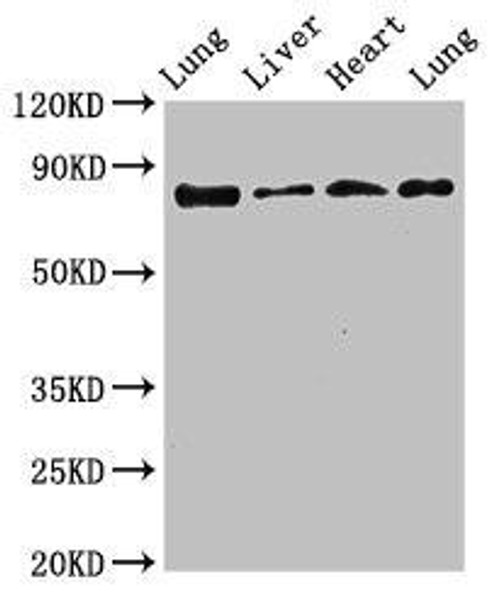
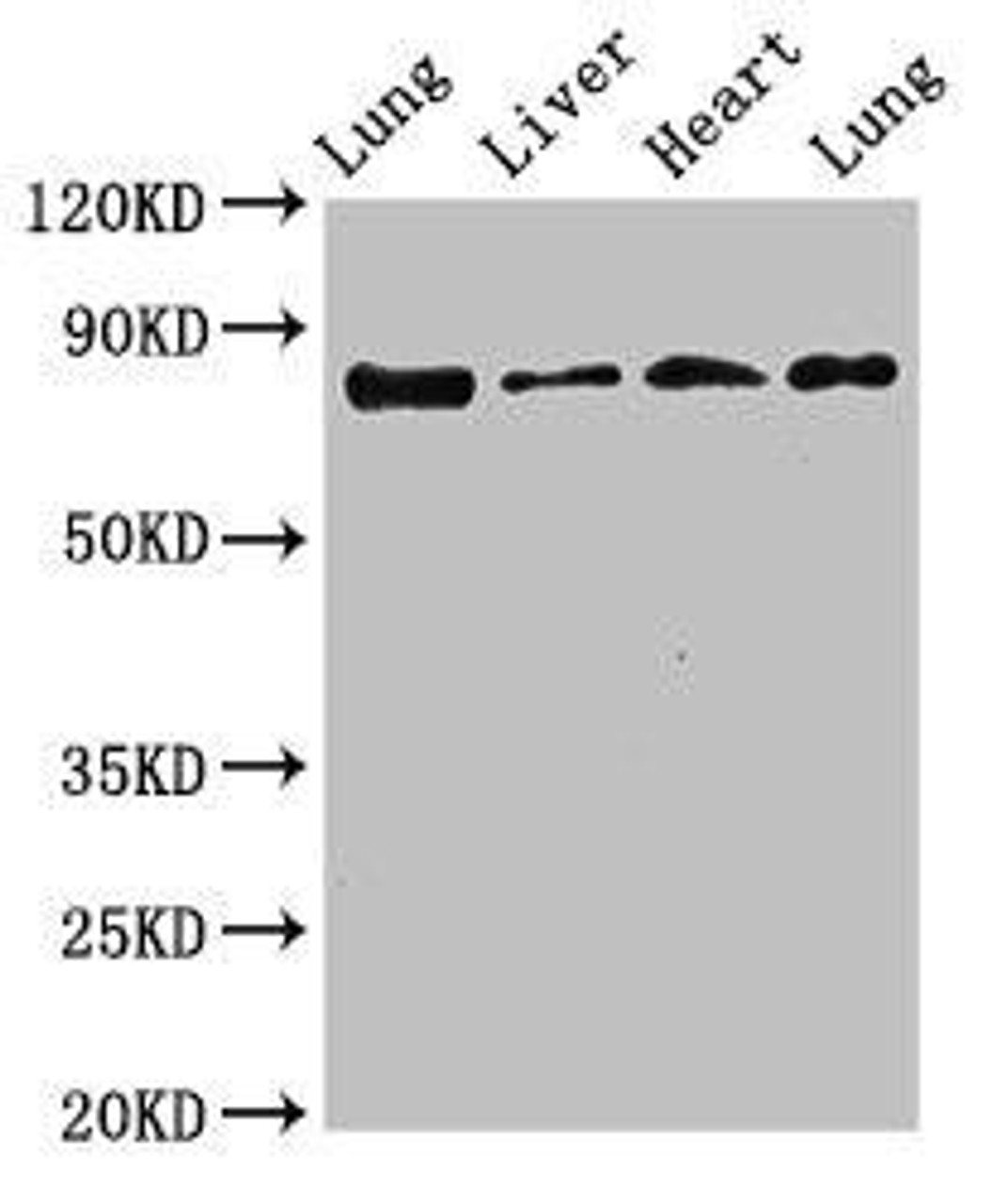
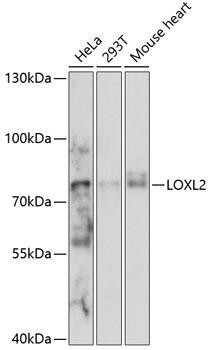
| UniProt Protein Function: | LOXL2: Mediates the post-translational oxidative deamination of lysine residues on target proteins leading to the formation of deaminated lysine (allysine). When secreted in extracellular matrix, promotes cross-linking of extracellular matrix proteins by mediating oxidative deamination of peptidyl lysine residues in precursors to fibrous collagen and elastin. Acts as a regulator of sprouting angiogenesis, probably via collagen IV scaffolding. When nuclear, acts as a transcription corepressor and specifically mediates deamination of trimethylated 'Lys-4' of histone H3 (H3K4me3), a specific tag for epigenetic transcriptional activation. Involved in epithelial to mesenchymal transition (EMT) via interaction with SNAI1 and participates in repression of E- cadherin, probably by mediating deamination of histone H3. Also involved in E-cadherin repression following hypoxia, a hallmark of epithelial to mesenchymal transition believed to amplify tumor aggressiveness, suggesting that it may play a role in tumor progression. Acts as a regulator of chondrocyte differentiation, probably by regulating expression of factors that control chondrocyte differentiation. Belongs to the lysyl oxidase family. |
| UniProt Protein Details: | Protein type:Oxidoreductase; Secreted; Cell adhesion; Secreted, signal peptide; EC 1.4.3.13 Chromosomal Location of Human Ortholog: 8p21.3 Cellular Component: basement membrane; extracellular space; nucleoplasm; nucleus Molecular Function:chromatin binding; electron carrier activity; methylated histone residue binding; protein binding; protein-lysine 6-oxidase activity; transcription corepressor activity Biological Process: aging; cell adhesion; collagen fibril organization; endothelial cell migration; endothelial cell proliferation; epithelial to mesenchymal transition; histone modification; negative regulation of transcription, DNA-dependent; positive regulation of chondrocyte differentiation; protein amino acid deamination; protein modification process; response to copper ion; response to hypoxia; sprouting angiogenesis |
| NCBI Summary: | This gene encodes a member of the lysyl oxidase gene family. The prototypic member of the family is essential to the biogenesis of connective tissue, encoding an extracellular copper-dependent amine oxidase that catalyses the first step in the formation of crosslinks in collagens and elastin. A highly conserved amino acid sequence at the C-terminus end appears to be sufficient for amine oxidase activity, suggesting that each family member may retain this function. The N-terminus is poorly conserved and may impart additional roles in developmental regulation, senescence, tumor suppression, cell growth control, and chemotaxis to each member of the family. [provided by RefSeq, Jul 2008] |
| UniProt Code: | Q9Y4K0 |
| NCBI GenInfo Identifier: | 13878585 |
| NCBI Gene ID: | 4017 |
| NCBI Accession: | Q9Y4K0.1 |
| UniProt Secondary Accession: | Q9Y4K0,Q53HV3, Q9BW70, Q9Y5Y8, B2R5Q0, |
| UniProt Related Accession: | Q9Y4K0 |
| Molecular Weight: | 86,725 Da |
| NCBI Full Name: | Lysyl oxidase homolog 2 |
| NCBI Synonym Full Names: | lysyl oxidase like 2 |
| NCBI Official Symbol: | LOXL2 |
| NCBI Official Synonym Symbols: | LOR2; WS9-14 |
| NCBI Protein Information: | lysyl oxidase homolog 2 |
| UniProt Protein Name: | Lysyl oxidase homolog 2 |
| UniProt Synonym Protein Names: | Lysyl oxidase-like protein 2; Lysyl oxidase-related protein 2; Lysyl oxidase-related protein WS9-14 |
| Protein Family: | Lysyl oxidase |
| UniProt Gene Name: | LOXL2 |
| UniProt Entry Name: | LOXL2_HUMAN |