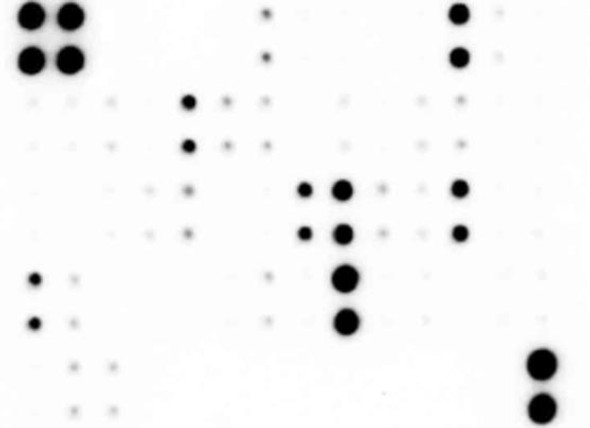


Description
Human RTK Phosphorylation Array (71 targets) (SARB0064)
The Human RTK Phosphorylation Array (SARB0064) from Assay Genie is a powerful tool for studying receptor tyrosine kinase (RTK) signaling pathways in human samples. This array kit allows for the simultaneous detection of phosphorylation levels of 71 different RTKs, providing comprehensive insight into the activation status of these critical signaling molecules.With high sensitivity and specificity, the Human RTK Phosphorylation Array enables researchers to investigate the dynamics of RTK signaling in various biological contexts, such as cancer, development, and immune response.
By analyzing the phosphorylation profiles of multiple RTKs in a single experiment, researchers can uncover key regulatory mechanisms and identify potential therapeutic targets for various diseases.This array kit is user-friendly and compatible with standard laboratory equipment, making it a valuable tool for both basic and translational research. By utilizing the Human RTK Phosphorylation Array, researchers can accelerate their studies on RTK signaling and ultimately advance our understanding of complex biological processes.
| Product Sku: | SARB0064 |
| Size: | 2, 4, or 8 |
| Species Detected: | Human |
| Number of Targets Detected: | 71 |
| Gene Symbols: | ABL1, AXL, BLK, BMX, BTK, CSF1R, CSK, DDR2, EGFR, EPHA1|EPHA2, EPHA3, EPHA4, EPHA5, EPHA6, EPHA7, EPHA8, EPHB1, EPHB2, EPHB3, EPHB4, EPHB6, ERBB2, ERBB3, ERBB4, FER, FGFR1, FGFR2, FGR, FLT4, FRK, FYN, HCK, IGF1R, INSR, ITK, JAK1, JAK2, JAK3, KDR, KIT, LCK, LTK, LYN, MATK, MET, MUSK, NGFR, NTRK2, PDGFRA, PDGFRB, PTK2, PTK2B, RET, ROR1, ROR2, ROS1, RYK, SLPI, SRMS, SYK, TEC, TEK, TIE1, TNK1, TNK2, TXK, TYK2, TYRO3, ZAP70 |
| Compatible Sample Types: | Cell Culture Supernatants, Cell Lysates, Plasma, Serum, Tissue Lysates |
| Design Principle: | Sandwich-based |
| Method of Detection: | Chemiluminescence |
| Pathway: | PI3K-AKT Signaling |
| Quantitative/Semi-Quantitative: | Semi-Quantitative |
| Solid Support: | Membrane |
| Suggested Application(s): | Multiplexed Protein Detection; Detection of Relative Protein Expression; Detecting Patterns of Cytokine Expression; Biomarker/ Key Factor Screening; Identifying Key Factors; Confirming a Biological Process |
| Storage/Stability: | For best results, store the entire kit frozen at -20°C upon arrival. Stored frozen, the kit will be stable for at least 6 months which is the duration of the product warranty period. Once thawed, store array membranes and 1X Blocking Buffer at -20°C and all other reagents undiluted at 4°C for no more than 3 months. |
| Hover over target for more information | ||||
|---|---|---|---|---|
ABL1
| ACK
| ALK-1
| Axl
| Blk
|
BMX
| Btk
| Csk
| Dtk
| EGFR
|
EphA1
| EphA2
| EphA3
| EphA4
| EphA5
|
EphA6
| EphA7
| EphA8
| EphB1
| EphB2
|
EphB3
| EphB4
| EphB6
| ErbB2
| ErbB3
|
ErbB4
| FAK
| FER
| FGFR1
| FGFR2
|
FGFR2 alpha isoform
| Fgr
| FRK
| Fyn
| Hck
|
HGFR
| IGF-1 R
| Insulin R (CD220)
| Itk
| JAK1
|
JAK2
| JAK3
| LCK
| LTK
| Lyn
|
MATK
| M-CSF R
| MUSK
| NGFR (TNFRSF16)
| PDGFRA
|
PDGFRB
| PYK2
| RET
| ROR1
| ROR2
|
ROS
| RYK
| SCF R (CD117/c-kit)
| SRMS
| SYK
|
Tec
| Tie-1
| Tie-2
| TNK1
| TRKB
|
TXK
| Tyk2
| TYRO10 (DDR2/TKT)
| VEGFR2
| VEGFR3
|
ZAP70
| ||||
- Easy to use
- No specialized equipment needed
- Compatible with nearly any liquid sample
- Proven technology
- Highly sensitive (pg/ml)
- Sandwich ELISA specificity
- Higher density than ELISA, Western blot or bead-based multiplex
- Human RTK Phosphorylation Antibody Array C1 Membranes
- Blocking Buffer
- Wash Buffer 1
- Wash Buffer 2
- Biotinylated Anti-Phospho Tyrosine Detection Antibody
- Streptavidin-Conjugated HRP
- Detection Buffer C
- Detection Buffer D
- Lysis Buffer (1 x 5 ml)
- Protease Inhibitor Cocktail
- Phosphatase Inhibitor Cocktail II
- 8-Well Incubation Tray
- Plastic Sheets
- Array Templates
Other Materials Required
- Pipettors, pipet tips and other common lab consumables
- Orbital shaker or oscillating rocker
- Tissue Paper, blotting paper or chromatography paper
- Adhesive tape or Saran Wrap
- Distilled or de-ionized water
- A chemiluminescent blot documentation system , X-ray Film and a suitable film processor, or another chemiluminescent detection system.
| 1. | Block membranes |
| 2. | Incubate with Sample |
| 3. | Incubate with Biotinylated Detection Antibody Cocktail |
| 4. | Incubate with HRP-Conjugated Streptavidin |
| 5. | Incubate with Detection Buffers |
| 6. | Image with chemiluminescent imaging system |
| 7. | Perform densitometry and analysis |