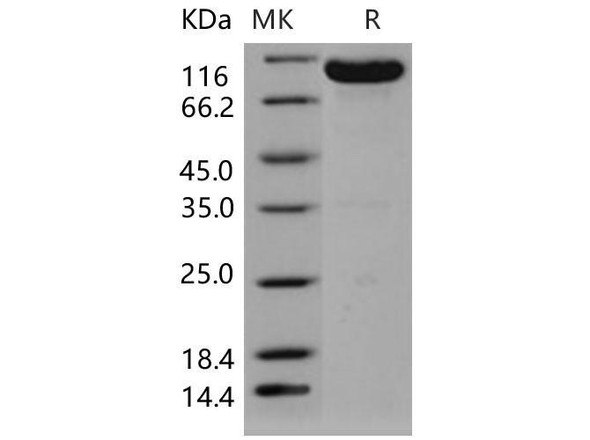


Description
| 抗体名: | EPHB4 Antibody (PACO45371) |
| 抗体コード: | PACO45371 |
| サイズ: | 50ul |
| 宿主種: | Rabbit |
| 申し込み: | ELISA, IHC |
| 推奨される希釈: | ELISA:1:2000-1:10000, IHC:1:20-1:200 |
| 反応性: | Human |
| 免疫原: | Recombinant Human Ephrin type-B receptor 4 protein (300-540AA) |
| 憲法: | Liquid |
| ストレージバッファ: | PBS with 0.02% sodium azide, 50% glycerol, pH7.3. |
| 精製方法: | Antigen Affinity Purified |
| 抗体のクローン性: | Polyclonal |
| アイソタイプ: | IgG |
| Conjugate: | Non-conjugated |
 | Immunohistochemistry of paraffin-embedded human liver tissue using PACO45371 at dilution of 1:100. |
 | Immunohistochemistry of paraffin-embedded human kidney tissue using PACO45371 at dilution of 1:100. |
| バックグラウンド: | Receptor tyrosine kinase which binds promiscuously transmembrane ephrin-B family ligands residing on adjacent cells, leading to contact-dependent bidirectional signaling into neighboring cells. The signaling pathway downstream of the receptor is referred to as forward signaling while the signaling pathway downstream of the ephrin ligand is referred to as reverse signaling. Together with its cognate ligand/functional ligand EFNB2 plays a central role in heart morphogenesis and angiogenesis through regulation of cell adhesion and cell migration. EPHB4-mediated forward signaling controls cellular repulsion and segregation form EFNB2-expressing cells. Plays also a role in postnatal blood vessel remodeling, morphogenesis and permeability and is thus important in the context of tumor angiogenesis. |
| シノニム: | Ephrin type-B receptor 4 (EC 2.7.10.1) (Hepatoma transmembrane kinase) (Tyrosine-protein kinase TYRO11), EPHB4, HTK MYK1 TYRO11 |
| NCBI Summary: | Ephrin receptors and their ligands, the ephrins, mediate numerous developmental processes, particularly in the nervous system. Based on their structures and sequence relationships, ephrins are divided into the ephrin-A (EFNA) class, which are anchored to the membrane by a glycosylphosphatidylinositol linkage, and the ephrin-B (EFNB) class, which are transmembrane proteins. The Eph family of receptors are divided into 2 groups based on the similarity of their extracellular domain sequences and their affinities for binding ephrin-A and ephrin-B ligands. Ephrin receptors make up the largest subgroup of the receptor tyrosine kinase (RTK) family. The protein encoded by this gene binds to ephrin-B2 and plays an essential role in vascular development. [provided by RefSeq, Jul 2008] |
| UniProt Code: | P54760 |
| NCBI GenInfo Identifier: | 495473 |
| NCBI Gene ID: | 2050 |
| NCBI Accession: | |
| UniProt Related Accession: | P54760 |
| Molecular Weight: | |
| NCBI Full Name: | tyrosine kinase |
| NCBI Synonym Full Names: | EPH receptor B4 |
| NCBI Official Symbol: | EPHB4 |
| NCBI Official Synonym Symbols: | HTK; MYK1; HFASD; CMAVM2; LMPHM7; TYRO11 |
| NCBI Protein Information: | ephrin type-B receptor 4 |
| UniProt Protein Name: | |
| UniProt Gene Name: |
| Antibodies | ELISA Kits |
| Anti-EPHB4 Antibody (CAB3293) | Human Ephrin type-B receptor 4 (EPHB4) ELISA Kit |
| EPHB4 Antibody (PACO02658) | |
| EPHB4 Antibody (PACO09112) |
| Secondary Antibody |
| Anti-HRP Goat Anti-Rabbit IgG (H+L) Antibody (CABS014) |
| Recommended Products |
| Anti-FITC Goat Anti-Rabbit IgG (H+L) Antibody (CABS011) |
| Anti-HRP-conjugated Beta Actin Antibody (CABC028) |