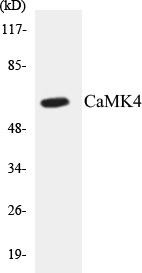
| バックグラウンド: | Calcium/calmodulin-dependent protein kinase that operates in the calcium-triggered CaMKK-CaMK4 signaling cascade and regulates, mainly by phosphorylation, the activity of several transcription activators, such as CREB1, MEF2D, JUN and RORA, which play pivotal roles in immune response, inflammation, and memory consolidation. In the thymus, regulates the CD4+/CD8+ double positive thymocytes selection threshold during T-cell ontogeny. In CD4 memory T-cells, is required to link T-cell antigen receptor (TCR) signaling to the production of IL2, IFNG and IL4 (through the regulation of CREB and MEF2). Regulates the differentiation and survival phases of osteoclasts and dendritic cells (DCs). Mediates DCs survival by linking TLR4 and the regulation of temporal expression of BCL2. Phosphorylates the transcription activator CREB1 on 'Ser-133' in hippocampal neuron nuclei and contribute to memory consolidation and long term potentiation (LTP) in the hippocampus. Can activate the MAP kinases MAPK1/ERK2, MAPK8/JNK1 and MAPK14/p38 and stimulate transcription through the phosphorylation of ELK1 and ATF2. Can also phosphorylate in vitro CREBBP, PRM2, MEF2A and STMN1/OP18. |
| シノニム: | Calcium/calmodulin-dependent protein kinase type IV (CaMK IV) (EC 2.7.11.17) (CaM kinase-GR), CAMK4, CAMK CAMK-GR CAMKIV |
| UniProt Protein Function: | CAMK4: a protein kinase of the CAMK1 family. Implicated in transcriptional regulation in lymphocytes, neurons and male germ cells. Two alternatively sliced isoforms have been described. |
| UniProt Protein Details: | Protein type:Protein kinase, Ser/Thr (non-receptor); Protein kinase, CAMK; EC 2.7.11.17; Kinase, protein; CAMK group; CAMK1 family Chromosomal Location of Human Ortholog: 5q21.3 Cellular Component: cytoplasm; cytosol; nucleolus; nucleoplasm Molecular Function:ATP binding; calcium-dependent protein serine/threonine kinase activity; calmodulin binding; calmodulin-dependent protein kinase activity Biological Process: adaptive immune response; epidermal growth factor receptor signaling pathway; fibroblast growth factor receptor signaling pathway; inflammatory response; innate immune response; long-term memory; myeloid dendritic cell cytokine production; myeloid dendritic cell differentiation; nerve growth factor receptor signaling pathway; nerve-nerve synaptic transmission; nucleocytoplasmic transport; peptidyl-serine phosphorylation; phospholipase C activation; positive regulation of protein export from nucleus; positive regulation of transcription, DNA-dependent; protein amino acid autophosphorylation; protein amino acid phosphorylation; regulation of osteoclast differentiation; regulation of T cell differentiation in the thymus; signal transduction; synaptic transmission |
| NCBI Summary: | The product of this gene belongs to the serine/threonine protein kinase family, and to the Ca(2+)/calmodulin-dependent protein kinase subfamily. This enzyme is a multifunctional serine/threonine protein kinase with limited tissue distribution, that has been implicated in transcriptional regulation in lymphocytes, neurons and male germ cells. [provided by RefSeq, Jul 2008] |
| UniProt Code: | Q16566 |
| NCBI GenInfo Identifier: | 2499586 |
| NCBI Gene ID: | 814 |
| NCBI Accession: | Q16566.1 |
| UniProt Secondary Accession: | Q16566,D3DSZ7, |
| UniProt Related Accession: | Q16566 |
| Molecular Weight: | 51,926 Da |
| NCBI Full Name: | Calcium/calmodulin-dependent protein kinase type IV |
| NCBI Synonym Full Names: | calcium/calmodulin-dependent protein kinase IV |
| NCBI Official Symbol: | CAMK4 |
| NCBI Official Synonym Symbols: | caMK; CaMK IV; CaMK-GR |
| NCBI Protein Information: | calcium/calmodulin-dependent protein kinase type IV |
| UniProt Protein Name: | Calcium/calmodulin-dependent protein kinase type IV |
| UniProt Synonym Protein Names: | CaM kinase-GR |
| Protein Family: | Calcium/calmodulin-dependent protein kinase |
| UniProt Gene Name: | CAMK4 |
| UniProt Entry Name: | KCC4_HUMAN |